
Choosing the Right Cable Starts with Speed — But Doesn’t End There
If you’re comparing Ethernet cable speeds, you’re not just looking for numbers—you’re trying to make a decision.
Which cable should I choose for my network?
Speed is only one part of the answer. Real-world performance depends on distance, environment, and long-term scalability. This guide is designed to help you move from speed comparison to confident selection, without needing multiple sources.
Ethernet Cable Speed Comparison (Quick Overview)
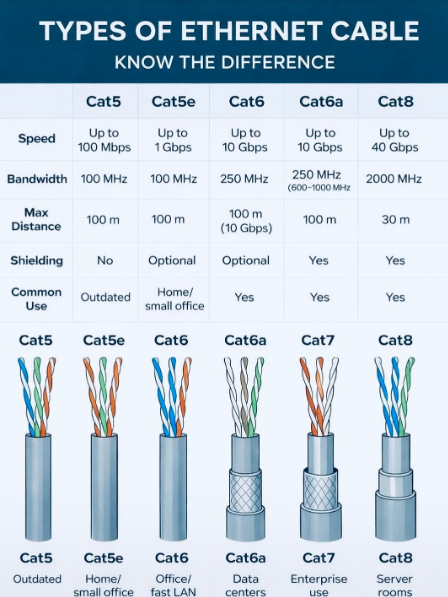
| Jenis Kabel | Max Speed | Bandwidth | Max Distance @ Max Speed | Kasus Penggunaan Umum |
|---|---|---|---|---|
| Cat5e | 1 Gbps | 100 MHz | 100 meters | Home / basic office |
| Cat6 | 10 Gbps | 250 MHz | 55 meters | Small business |
| Cat6a | 10 Gbps | 500 MHz | 100 meters | Enterprise networks |
| Cat7 | 10 Gbps | 600 MHz | 100 meters | Shielded environments |
| Cat8 | 25–40 Gbps | 2000 MHz | 30 meters | Data centers |
Key takeaway:
Cat6a delivers the most stable 10Gbps performance for standard installations, while Cat8 is designed for short-distance, high-speed environments.
What Each Cable Category Actually Means
Understanding the category differences helps avoid overbuying or under-specifying.
Cat5e (Category 5e)
Cat5e is the most widely deployed legacy Ethernet cable. It supports up to 1 Gbps over 100 meters and is sufficient for most residential networks, basic office setups, and internet access below gigabit speeds.
Best for: home networks, small offices, low-cost installations
Cat6 (Category 6)
Cat6 improves on Cat5e with higher bandwidth and better crosstalk control. It can support 10Gbps, but only over shorter distances (up to ~55 meters).
Best for: small business networks, short-run 10G applications
Cat6a (Category 6 Augmented)
Cat6a is the standard choice for modern structured cabling. It supports full 10Gbps performance over 100 meters and provides better shielding against interference.
Best for: enterprise networks, building infrastructure, future-proof installations
Cat7 (Category 7)
Cat7 cables offer higher shielding and bandwidth, but are less commonly used in standard RJ45-based deployments. They are typically found in specialized environments requiring strong EMI protection.
Best for: industrial or high-interference environments
Cat8 (Category 8)
Cat8 is designed for high-speed data center applications, supporting 25Gbps or 40Gbps over short distances (up to 30 meters). It is not intended for general office or building cabling.
Best for: data centers, high-speed switch-to-server connections
Speed Depends on Distance (Critical Insight Most Buyers Miss)
One of the most important factors in cable performance is distance.
A cable rated for 10Gbps does not guarantee that speed across all lengths:
- Cat6 supports 10Gbps only up to ~55 meters
- Beyond that, performance drops significantly
- Cat6a maintains 10Gbps up to 100 meters
This is why many installations fail to meet expectations—not because of the cable category, but because of incorrect assumptions about distance.
Choose Based on Your Application Scenario
Instead of focusing only on specifications, it’s more effective to map your requirement to a real-world scenario.
Home Networks
Streaming, gaming, and general internet use typically do not require more than 1 Gbps.
Recommended: Cat5e or Cat6
Office and Small Business
VoIP systems, file sharing, and moderate traffic benefit from higher performance and stability.
Recommended: Cat6
Enterprise and Building Infrastructure
Long cable runs and structured cabling demand consistent 10Gbps performance.
Recommended: Cat6a
Data Center Environments
High-speed switching and server connections require higher bandwidth but over shorter distances.
Recommended: Cat8
High Interference Environments
Factories or industrial installations may experience electromagnetic interference.
Recommended: Shielded Cat6a or Cat7
Practical Selection Guidelines (Fast Decision Rules)
If you’re trying to decide quickly, these rules cover most use cases:
- For standard gigabit networks, Cat5e is sufficient
- For 10Gbps under short distances, Cat6 works well
- For 10Gbps over full 100 meters, Cat6a is the reliable choice
- For high-speed short-distance applications, consider Cat8
- When in doubt, Cat6a provides the best balance of performance and longevity
Cost vs Performance: What You Are Really Paying For
Higher category cables are not just about speed. The cost increase typically reflects:
- Improved shielding and reduced interference
- Higher bandwidth capacity
- Better long-distance performance
- Increased reliability over time
In most cases:
- Cat6 offers a lower upfront cost
- Cat6a provides better long-term value
- Cat8 carries a premium for specialized use
A common pattern is that buyers focus too much on maximum speed and overlook installation constraints such as distance and environment.
Common Mistakes to Avoid
Many purchasing decisions fail due to predictable errors:
Choosing based only on advertised speed without considering distance
Selecting Cat7 without understanding compatibility requirements
Using Cat8 in general office environments where it offers no benefit
Ignoring interference and installation conditions
Avoiding these mistakes can significantly improve network performance and reduce unnecessary costs.
Expert Insight from Real Deployments
In structured cabling projects across enterprise and telecom environments, several consistent patterns emerge:
- Cat6a has become the default baseline for new installations
- Cat6 remains relevant for short-distance or budget-sensitive deployments
- Cat8 is only deployed when there is a clear requirement for 25G or 40G
From a long-term perspective, selecting the right cable at the beginning reduces the risk of future upgrades and network limitations.
Final Recommendation
For most professional and scalable network deployments:
Cat6a is the most balanced and future-ready choice
It delivers stable 10Gbps performance across standard distances, strong resistance to interference, and compatibility with modern infrastructure requirements.
Need Help Choosing the Right Cable?
If you’re planning a project and need to select the right Ethernet cable, focus on:
- Required network speed
- Cable run distance
- Installation environment
- Budget and future scalability
Making the correct choice early can prevent performance issues, reinstallation costs, and long-term limitations.